Osculating circles
19 October, 2021 (Tuesday)
Last modified: 02:11 AM - 20 October, 2021
PDF versionEDIT: This post is redundant. You may directly check the explanation in the solution for exercise 5 from the solutions to exercise sheet 5.
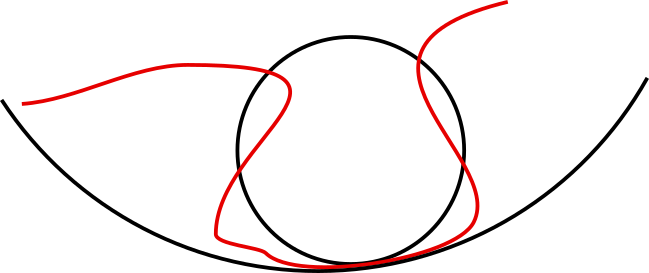
This figure is useful for exercise 5 from exercise sheet 5.
The red curve is the curve whose curvature we are trying to study.
The smaller black circle is said to be too small because at least some part of the red curve around the point of contact lies outside the circle (some of the red curve lies inside too, but curvature only depends of the vicinity of the point where we intend to study the curvature).
On the other hand, in the vicinity of the point of contact (in fact, in this case, the entire curve), the red curve lies inside the bigger black circle.
The smaller circle is, therefore, too small, and the bigger circle too big. If we keep enlargening the smaller circle, for some radius, the circle will switch from being too small (some part of the red curve around the point lying inside the circle) to being too large (some part of the red curve around the point lying outside the circle). The radius of the circle that is responsible for the switch may be considered to be neither too big (in the sense described above) nor too small, and is therefore a best approximation. As the exercise shows, its radius happens to be exactly the reciprocal of the curvature.